
Every few years, SBA updates its size standards for small businesses. In most years, these updates, while notable, are not groundshaking, and usually just account for inflation. That cannot be said of the most recent proposed changes. We do not use hyperbole here, but, sometimes, emphatic language must be used. SBA is proposing what can only be described as absolutely massive changes to its size standards for small business contracting. On August 19, 2026, SBA released its proposal for what can only be described as a new size standard paradigm. We explore these in greater detail here, and plan on one or more follow-up posts as there are multiple aspects of the system that would be changed if the proposal is finalized.
Overview
There are going to be significant changes all around. For the first part of SBA’s proposal, it explains that it will be changing the NAICS level at which size standards are calculated from the full 6-digit NAICS code to the higher level 4 and 5-digit NAICS code levels, the ones that reflect broader industries. This would reduce the number of size standards to 338 size standards. In addition, while SBA is limited in how much it can do by statute, it is also moving several industries from receipts-based size standards to employment-based size standards. Per SBA, this will be the default plan unless an industry is squarely a services industry. We intend to explore these matters more in a separate post, as, while important, they will for many be the secondary issue with the new proposed standards.
New Methodology
The most impactful proposed changes overall are to the size standards themselves. Looking at the methodology offered by SBA for its numbers, SBA explains:
In the 2024 Methodology, the SBA used seven factors for calculating size standards: simple average firm size, weighted average firm size, average assets per firm, national four firm concentration ratio, national Gini coefficient, and two disparity measures of federal contracts for any industries which received at least $20 million in federal contracts. By contrast, the proposed Revised Methodology uses three: national industry size, number of geographic markets, and an adjustment for net imports, which are combined together into an average market size measure.
The language “average market-size measure” is notable. This suggests that the SBA is looking to use the mean (or average) market size as a determinant, as opposed to a median market size as a determinant. A separate document appears to confirm this analysis. Along with the proposed size standards, SBA released a proposed rule on its methodology for calculating said size standards. Again, SBA confirms that: “Average market size is chosen as the single most appropriate measure for determining small business size standards because SBA can then compare a firm’s size to its industry group or industry’s average market size to get the firm’s approximate market share.” SBA states that “[t]he changes in factors is intended to more closely align the size standard’s methodology with the Small Business Act’s statutory language requiring a small business concern to be one which is ‘not dominant in its field of operations’.” In other words, if a business simply doesn’t “dominate” its industry, it should be viewed as small per the statute.
Per SBA, it is viewing $30.6 million in receipts as the low point, the anchor by which all other receipts-based size standards are measured. Its basis for this number is that, when the initial size standard of $1 million was used for receipts-based size standards, SBA has only increased that standard to account for inflation, which produces a figure of just $9.7 million for 2026. But, per SBA, when productivity gains are taken into account, the number should be $30.6 million. Thus, the calculation is as follows:

SBA bases this on an exponent shown in the formula above. That exponent is arrived at using the above-mentioned $30.6 million as a “low anchor” point and a “high anchor” of $500 million in a market of $20 billion. The reason SBA gives for this high anchor is that “a firm with $500 million in receipts would not be dominant in a market with $20 billion in receipts, since it would have a low market share of 2.5 percent.” The result of this approach is that, in many cases, the size standards will increase by unprecedented, titanic leaps. We are not talking increases of a few million, or even tens of millions, but hundreds of millions of dollars.
Take, for instance, NAICS 484110, “General Freight Trucking, Local.” Presently, this industry has a size standard of $34 million. SBA proposes to increase that to $245 million. Or, how about for one we often see, NAICS 541511, “Computer Systems Design Services,” which has a present size standard of $34 million. SBA would increase that standard by more than ten times to $531 million. Another example would be Engineering Services (541330), proposed to increase to $252 million from $25.5 million (resulting in an estimated 1469 new small businesses). Proposed numbers can, in some cases, only be described as unfathomable: $1.011 billion for NAICS 523940,“Portfolio Management and Investment Advice,” for example.
Employment-based size standards should see significant increases as well. Per SBA, the anchor size has long been 500 employees.
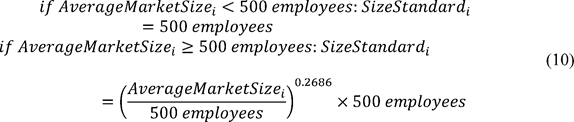
Per SBA, the exponent chosen is based on the 500 employee “low anchor” and a 2,500 employee “high anchor” that would apply for a market where there are 200,000 employees in the industry, as a company with 1.25% of an industry’s employees would “not be dominant.” The result is more substantial jumps in size standards: NAICS 333517, “Machine Tool Manufacturing,” would go from 500 employees to 1,800 employees. 334416, “Transformer and Other Inductor Manufacturing,” would increase from 550 employees to 2,800 employees. While the jumps appear somewhat less drastic than the receipts-based size standards, these shifts will nonetheless bring thousands of new competitors into the small business set aside market. Also, notably, the non-manufacturer rule does not appear to be mentioned, with its standard of 500 employees.
We try to avoid our own commentary on the advisability of actions taken by the SBA, and shall not deviate from that here. With that said, we will note that these increases would be unparalleled in scale. Although we note SBA’s estimate of an increase of about 100,000 newly minted small businesses from these rules: “The changes to the size standards would result in a net increase of about 114,541 businesses classified as small.”
Companies that previously were nowhere close to any small business size standard now stand to fall under such a categorization under the majority of size standards. Companies with revenues of hundreds of millions, even above a billion, dollars per year will be permitted to compete against companies with revenues in the range of six and seven figures. This will put extreme competitive pressure on thousands of currently small businesses. The statute does speak of “dominance” of a market as the test, but what makes a company “dominant” in a market is itself a question of interpretation, and on that SBA has leeway on interpreting. We think it may be prudent for SBA to take a closer look at the potential impact of its plans. Perhaps a new category of startup small businesses could be created, with competition for certain contracts limited to those just getting started. The proposed rule says nothing about that, however.
SBA has established a period for commentary by the public until September 21, 2026. If you are interested in providing commentary on this proposed rule, you may do so here. We will have more thoughts on this proposed rule soon.
Questions about this post? Email us. Need legal assistance? Call us at 785-200-8919.
Looking for the latest government contracting legal news? Sign up for our free monthly newsletter, and follow us on LinkedIn, Twitter and Facebook.